The 2nd International Conference on Frontiers of Corpus-based Interdisciplinary Research was successfully held at Xi'an Jiaotong University (XJTU) from November 14 to 16, 2025. Co-hosted by the School of Foreign Studies (SFS) of XJTU and the Corpus Linguistics Society of China, the conference was co-organized by the Editorial Office of Foreign Language Education and the Editorial Office of Journal of Xi'an International Studies University.
Focusing on the Interdisciplinary Integration of Corpus Research in the AI Era, the conference invited more than 10 leading experts in corpus research worldwide to deliver keynote speeches, attracting nearly 200 faculty members and students from universities across the UK, the US, Japan, Germany, France, New Zealand, Malaysia and other countries and regions.
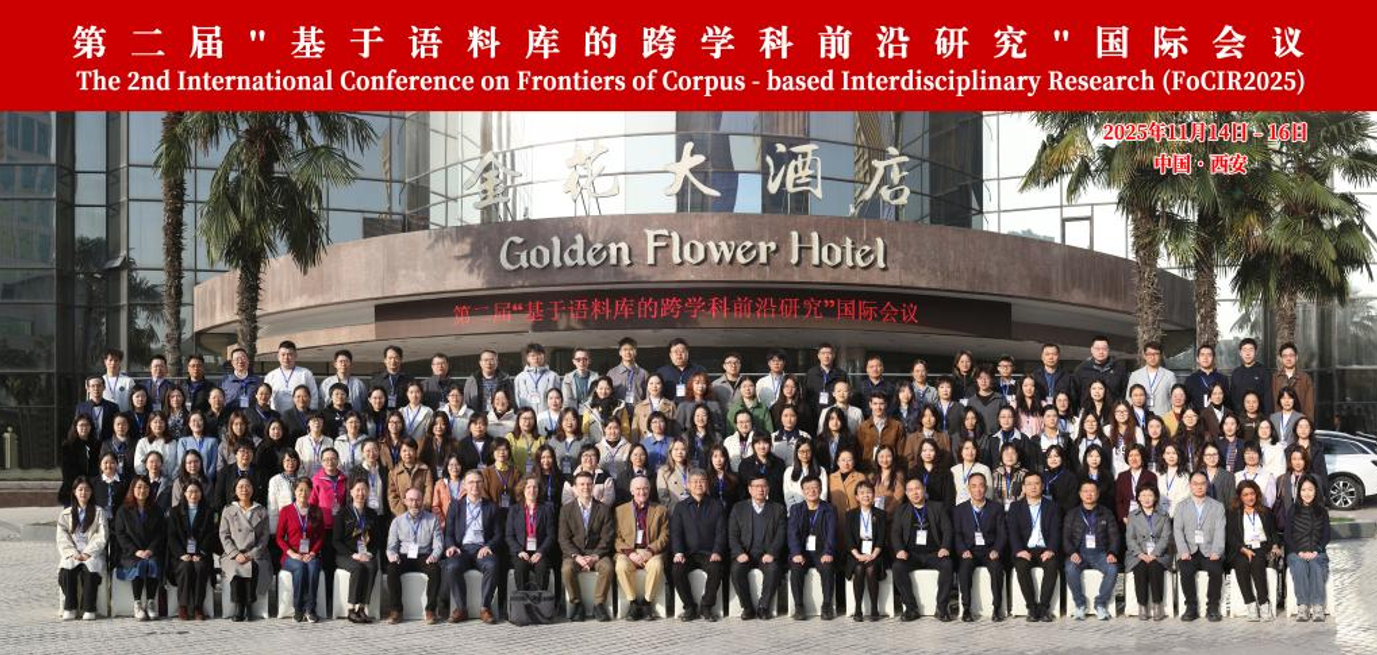
The three-day event featured pre-conference workshops, keynote speeches, and parallel sessions.
On November 14, a series of hybrid pre-conference workshops were successfully held. Distinguished international scholars, including Professor Paul Rayson, Professor Vaclav Brezina, and Professor Paul Baker from Lancaster University, UK, and Professor Laurence Anthony from Waseda University, Japan, engaged in in-depth discussions with over 100 participants focusing on corpus construction in the AI era, research methods of corpus-AI integration, and practical applications of combining corpora with AI models, kicking off the conference.
The opening ceremony was held on the morning of November 15, presided over by Chen Xiangjing, Dean of SFS at XJTU. Sun Zao, Deputy Party Secretary of the CPC XJTU Committee, and Professor Tony McEnery, a world-renowned expert in corpus linguistics and Distinguished Professor at Lancaster University, UK, attended and addressed the ceremony.
On behalf of XJTU, Sun Zao extended a warm welcome to all guests. He noted that XJTU, inheriting the Westward Relocation Spirit and fulfilling its national missions, has built the Western China Science and Technology Innovation Harbour (iHarbour) into a new global hub for education and research. He highly acknowledged the leapfrog development of the Foreign Languages and Literature discipline, which ranked among the top 9% in the 2025 ShanghaiRanking's Best Disciplines in China for the first time. He pointed out that the rapid development of information technology has opened new avenues for the interdisciplinary integration of technological innovation and linguistic research. He expressed the hope that scholars would deepen interdisciplinary explorations in such fields as AI and corpus construction, corpus and language teaching, linguistic data statistics, social sciences, translation studies, so as to advance the development of New Liberal Arts and interdisciplinary integration.
Professor Tony McEnery remarked that the past five years have witnessed revolutionary progress in corpus studies, especially the unprecedented opportunities and research potential unlocked by AI. He underscored the value of international interdisciplinary exchanges and looked forward to further deepening dialogue and cooperation between Chinese and British scholars to jointly advance research across multiple fields including corpus linguistics. He expressed his appreciation for the enthusiastic participation in the workshops and voiced confidence that the conference would yield valuable academic achievements.
In the keynote session, international scholars including Tony McEnery, Vaclav Brezina, Paul Baker and Michaela Mahlberg, as well as Chinese professors such as Liang Maocheng from Beihang University, Huang Libo from Xi'an International Studies University, Hu Kaibao from Shanghai International Studies University and Sang Zhonggang from XJTU, shared insights on cutting-edge topics including AI and applied linguistics, integration of AI and traditional corpus research, applications of large language models in corpus studies, literary translation and computational stylistics, corpus-based analysis of writer's style, theoretical construction of corpus linguistics in the AI era, multimodal corpus research, and corpus-based analysis of English translations of Dunhuang manuscripts. The keynote reports jointly constructed a critical integration paradigm of corpus linguistics in the AI era from three dimensions: ethics and philosophy, methodology and dialectics, and technical practice, thereby highlighting the core value of linguistics in the field of digital humanities.
On the afternoon of November 15, 12 parallel sessions were held in the Shaw Building on Xingqing Campus. Participants engaged in extensive and in-depth discussions on interdisciplinary topics such as corpus and AI, corpus and linguistic data, language data and media, and language data and language teaching.
The conference closed successfully on the morning of November 16. Cheng Bing, Vice Dean of SFS, presided over the closing ceremony, expressing sincere gratitude to all guests, co-organizers, staff members and volunteers, and reviewing the wonderful moments of academic exchanges during the conference.
Following the successful convening of the inaugural session in 2023, this conference has once again become a high-level academic event for corpus-based interdisciplinary research organized by SFS at XJTU. It has built a high-end platform for academic dialogue between domestic and international scholars, vigorously promoted theoretical and methodological innovation of corpus linguistics, interdisciplinary integration, and international academic exchanges in the intelligent era. It is of great significance for facilitating the intelligent upgrading of New Liberal Arts development.


