On June 8, 2025, the Shaanxi Regional Final and Award Ceremony of the 30th China Daily "21st Century Cup" National English Speaking Competition concluded at Xi'an Mingde Institute of Technology. Two XJTU students achieved remarkable results, with Li Feiyi from the School of Management winning the Grand Prize (Second Place overall), and Liu Ziyan from the School of Computer Science and Technology claiming the Second Prize. They will join fellow student Wang Feiran, who has secured direct entry to the national finals, to represent XJTU in the national round.
Established by China Daily in 1996, the "21st Century Cup" National English Speaking Competition has evolved into one of the most prestigious national contests officially recognized by China's Ministry of Education. The competition also serves as the only official selection platform in China for the International Public Speaking Competition (IPSC). Supported by academic institutions including the English-Speaking Union (ESU) and Teachers of English to Speakers of Other Languages (TESOL), the competition adopts a three-tier structure—campus trials, regional competitions, and the national final—to provide young students with a pathway from local stages to international arenas, and foster their ability to better narrate China's stories.
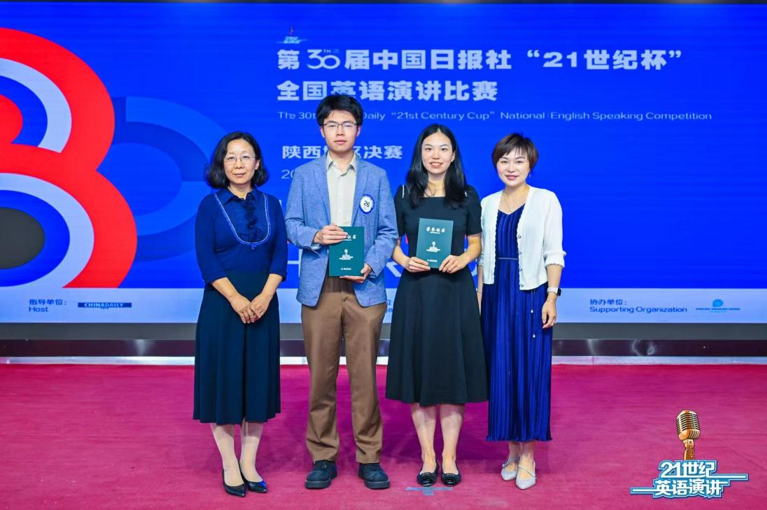
This year's regional final brought together 35 contestants from nearly 20 universities across Shaanxi Province. The competition comprised three segments: prepared speech, impromptu speech, and Q&A session.
In the prepared speech segment, themed "Live within and beyond the 21st Century", XJTU participants offered compelling insights into how to preserve humanistic values in an era of rapid technological advancement, and how to address the challenges posed by artificial intelligence (AI). During the impromptu speech and Q&A rounds, the two students earned high praise from the judges for their thoughtful responses to the impact of social media on modern life.
In preparation for the competition, XJTU adopted a training approach that combined collective guidance with personalized coaching. It also used AI tools for content generation and language refinement to enhance the coaching effectiveness. This dual-mode strategy ensured consistency in foundational training while catering to the unique strengths of each contestant, ultimately maximizing their competitive performance.
Looking ahead, the SFS will continue to leverage its language competition base and specialized teaching teams to promote a collaborative model integrating curriculum development, technological empowerment, and practical training. Through this approach, XJTU aims to create a rich and supportive foreign language learning environment and cultivate well-rounded talents with strong language proficiency and a global perspective.


