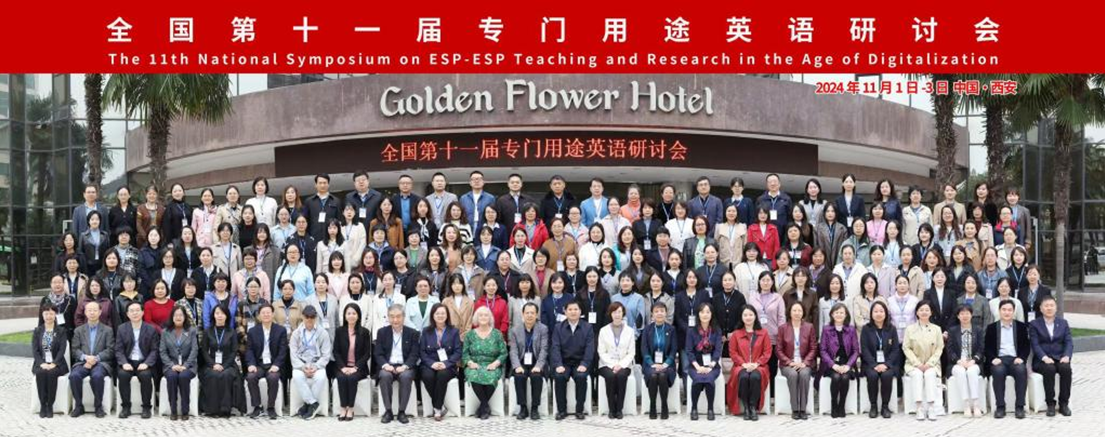
The 11th National Symposium on English for Specific Purposes (ESP), hosted by SFS at XJTU, concluded on November 3 after three days of intensive academic exchanges. Co-organized by the editorial boards of China ESP Research and Foreign Language Education, alongside Foreign Language Teaching and Research Press (FLTRP), the event attracted over 200 participants from 80 universities worldwide, featuring seven keynote speeches, workshops, panel discussions, and innovative teaching demonstrations.
The symposium commenced with a series of workshops on November 1. Three cutting-edge sessions set the tone: Prof. Tony Xing Tan (University of South Florida) explored AI’s role in ESP education; Prof. Qian Xi (XJTU) demonstrated AI tools in EAP teaching; and Prof. Hilary Nesi (Coventry University) shared insights on academic publishing. Participants praised the workshops for blending theory with practice.
On November 2, the official opening ceremony was held at XJTU, with Assistant to President Huang Zhongde extending a warm welcome. He highlighted XJTU’s commitment to advancing ESP research and nurturing talent for national development. Prof. Sun Youzhong, Chair of the National Advisory Board for Foreign Language Education, emphasized ESP’s pivotal role in China’s academic modernization and interdisciplinary collaboration.
The symposium’s academic core featured seven keynote speeches by globally renowned scholars. On November 2, Prof. Hilary Nesi (Coventry University) analyzed the decline of traditional dictionaries amid AI-powered learning trends, while Prof. Lillian Wong (University of Hong Kong) showcased corpus-based methods to enhance disciplinary writing. Prof. Qian Jing (Tsinghua University) discussed AI’s transformative impact on general education, and Prof. Huiling Ding (North Carolina State University) addressed ethical challenges in AI-integrated curricula.
On November 3, Prof. Jiang Yajun (Xi’an International Studies University) explored identity dynamics in bilingual academic writing, followed by Dr. Chang Xiaoling (FLTRP), who advocated for digital empowerment in ESP course design. Prof. Yang Ruiying (XJTU) concluded with a historical review of ESP’s evolution through its flagship journal.
Parallel events enriched the symposium. On November 2 afternoon, team-teaching demonstrations in legal, technical, aviation, and medical English showcased ESP’s real-world applications. Six parallel forums further delved into ESP curriculum design, assessment, and technology integration.
The editor’s forum on November 3 offered guidance for academic publishing, with editors from Journal of English for Academic Purposes, Foreign Languages and Their Teaching, and other journals sharing submission strategies for scholarly articles and addressing AI’s impact on research.
The closing ceremony, chaired by Prof. Cheng Bing (XJTU), featured remarks by Prof. Li Liwen (Beijing Foreign Studies University), who lauded the symposium’s role in advancing ESP education and fostering international cooperation. A commemorative video highlighted key moments, encapsulating the vibrant exchange of ideas among participants.
With its focus on AI integration, interdisciplinary innovation, and ethical pedagogy, the symposium set new benchmarks for ESP research and teaching, reinforcing its significance in shaping the future of language education in China and beyond.


