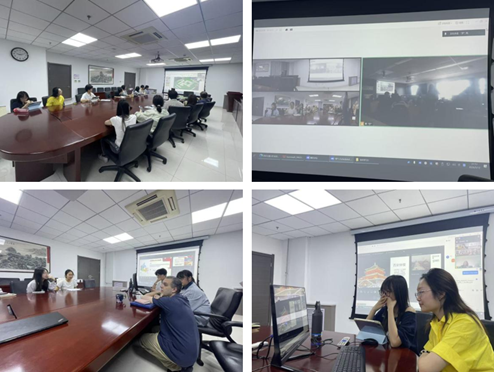
SFS has successfully organized three sessions of international collaborative learning activities under XJTU's "International Cooperative Dual-Star Companion Learning Project", a joint initiative with Cégep de Sainte-Foy in Quebec, Canada. Led by Professor Fan Jingwei from the French Department, the project adopted a blended learning model, which integrated online and in-person instruction into the compulsory undergraduate course "Basic French Audio-Visual", aiming to advance language practice, cultural exchange, and mutual skill development between Chinese and Canadian students.
The first two sessions of collaborative learning were conducted through asynchronous online exchanges, allowing students to complete tasks flexibly, share their work, and engage in peer review. The third session adopted a synchronous online format, featuring thematic discussions on Chinese and Canadian cultures.
A distinctive feature of the project was its language-exchange approach. Canadian students used Chinese to introduce traditional Chinese architecture, regional cuisines, and the historical and cultural charm of Xi'an as an ancient capital of China. Chinese students, meanwhile, used French to present Canada's geography, the dynamics of its bilingual society, Quebec's system for protecting the French language, and the country's multicultural social structure.
Throughout the exchanges, both groups students demonstrated solid language proficiency and broad international perspectives. By communicating in authentic multilingual settings, they strengthened their practical language skills and developed a deeper understanding of each other's cultures.
The teaching teams from both institutions worked closely to overcome practical challenges, including the 12-hour time difference, limitations of cross-border communication platforms, and the constraints of online collaboration. The original plan to organize mixed China–Canada student groups proved impossible.
In response, the instructors promptly adapted the project design. They shared responsibility for coordinating communication, relaying learning materials and students' work, facilitating task management, and compiling peer feedback. A revised collaboration model was eventually adopted, in which Chinese and Canadian students completed tasks within their respective groups before exchanging outcomes for mutual review and feedback. This flexible approach ensured the smooth and effective implementation of the collaborative learning project.
Students from both sides responded enthusiastically to the collaborative learning, praising the project as an engaging and rewarding opportunity for international exchange. Throughout the activities, they communicated openly, listened attentively to one another, and expressed appreciation for their peers' language proficiency and cultural knowledge.
Thanks to the joint efforts of the teaching teams and students, all three sessions of collaboration were carried out successfully, yielding meaningful learning outcomes. The project not only strengthened students' practical language skills and intercultural competence, but also fostered mutual understanding and lasting friendships between young people from China and Canada.
The successful completion of the three collaborative learning activities marks an important milestone in the SFS's participation in XJTU's "International Cooperative Dual-Star Companion Learning Project", while providing valuable experience for integrating international collaboration into foreign language education.
Looking ahead, SFS will continue to deepen its partnership with Cégep de Sainte-Foy, further refine its cross-cultural collaborative learning model, and create more opportunities for students to develop multilingual competence, intercultural communication skills, and a global outlook. Through such initiatives, SFS remains committed to preparing internationally minded graduates who can thrive in an increasingly interconnected world.


