From May 11 to 13, Professor Liu Haitao, a renowned quantitative linguist at Fudan University, visited SFS. He delivered two academic talks titled When Data Meets Language: A Journey to Decoding Human Intelligence at the iHarbour and Xingqing campuses.
In his lectures, Professor Liu noted that humanity is transitioning from an era of "using tools" to a "digital-intelligent era of co-existence with another intelligent life". He argued that digital intelligence, emerging from big data, has already taken shape and begun to exhibit autonomous behaviors, posing new challenges for humans to understand and interpret intelligent systems.
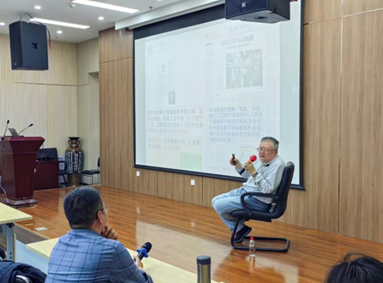
Reviewing the history of artificial intelligence, Professor Liu noted that machines, through training with artificial neural networks, can acquire and integrate large-scale knowledge in extremely short spans of time, representing an unprecedented development in human history.
He argued that the emergence of large language models marks a historical turning point for linguistics. It exposes the limitations of traditional linguistic theories and reveals that language is not a static system of rules, but a probabilistic system shaped by massive networks of usage-based relations. Linguistic research must shift from prescribing rules based on individual intuition to uncovering patterns and modeling collective language behavior through empirical, interdisciplinary approaches. He called on linguists to embrace this transformation proactively, serve as a bridge between human and machine intelligence, and advance a new, data-driven paradigm of linguistics.
Professor Liu's team has achieved a series of cutting-edge results in data-driven linguistic research. First, by analyzing sentence-length distributions, they identified a distinctive 2-3-1-4 patterning in Chinese "running-stream" sentences—characterized by alternating long and short units—which contrasts sharply with the incremental 1-2-3-4 pattern observed in most languages. Second, through quantitative analyses of dependency distance and dependency relations, they provided robust evidence for the universal Dependency Distance Minimization principle across human languages. These studies have been published in leading international journals and garnered citations across 22 Scopus subject categories, underscoring the strong explanatory power of quantitative linguistic research.
Responding to widespread concerns about the career prospects of humanities students, Professor Liu Haitao emphasized that their core competitiveness lies in the ability to engage in deep, efficient communication with AI. He advised foreign language majors to adopt a data-driven perspective, applying data science methods to analyze linguistic patterns and understand the inner workings of AI—so as to enhance their own capabilities by leveraging this technology.
During the Q&A session, faculty and students engaged in in-depth discussions with Professor Liu on topics ranging from the linguistic patterns of large language models, AI consciousness, to linguistics-enabled AI interpretability, and AI's role in theoretical construction. Professor Liu stressed that linguists' most urgent task today is to uncover the origins of AI intelligence; only by mapping out these underlying principles can humans collaborate with AI on an equal footing, rather than being passively swept along by its tide. In his concluding remarks, he defined intelligence as the capacity to adapt to change, and underscored that neither the world nor humanity can do without the humanities—even as the humanities themselves stand in urgent need of transformation and renewal.
During his visit, Professor Liu Haitao was presented with a certificate appointing him as a Senior Member of the Strategic Advisory Committee of SFS. University faculty representatives held in-depth discussions with him on teaching, research, talent cultivation, and disciplinary development. SFS will draw on his cutting-edge insights to advance interdisciplinary research at the intersection of language and data, refine its talent cultivation framework, strengthen discipline building, and drive high-quality development.


