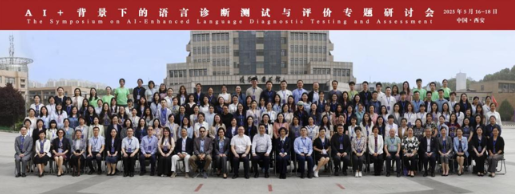
From May 16 to 18, 2025, the Symposium on AI-Enhanced Language Diagnostic Testing and Assessment was held at XJTU. This event invited over 10 leading experts in the language testing field and attracted nearly 200 scholars from over 100 universities and institutions across China and abroad, aiming to explore the innovative development of generative artificial intelligence (AI) technologies in language testing and assessment.
The symposium was organized by the CACSEC Association for Language Testing and Assessment, hosted by SFS, and co-sponsored by editorial boards of leading Chinese journals including Foreign Language Testing and Teaching, Language Testing and Assessment, Foreign Language Education, and Journal of Beijing International Studies University.
The symposium began on May 16 with three workshops, featuring three cutting-edge topics: Item Analysis and Test Equating of Rasch-GZ in the Age of AI, AI-empowered academic visualization, and AI-empowered cognitive diagnostic assessment.
The opening ceremony took place on the morning of May 17, with remarks from Hong Jun, Vice President of XJTU; and Liu Jianda, President of the CACSEC Association for Language Testing and Assessment. Both highlighted the significance of the integration of AI technologies and language testing and assessment.
Four keynote speeches followed: Professor Liu Jianda explored the development of AI-enabled formative assessment and its implications for personalized feedback and developmental support; Professor Cheng Liying emphasized embracing AI to create impact-driven and diagnostic-driven assessment, learning and teaching; Professor Luke Harding discussed new frameworks for assessing communicative competence in tech-mediated environments; and Professor Vahid Aryadoust examined the oracy assessment for Learning in the Age of Generative AI.
The symposium continued with 6 special sessions and 12 parallel sessions, addressing a wide array of topics involving AI empowerment and language testing practice.
Another four keynotes were held on May 18. Professor Jin Yan addressed university policies and educator perspectives toward AI use; Professor Xie Qin presented test washback research through bibliometric analysis; Professor Yan Xun discussed the role of AI in local language testing; and Professor Meng Yaru shared insights on cognitive diagnosis and AI-enhanced feedback mechanisms.
The Editors-in-Chief Panel was chaired by SFS Vice Dean Cheng Bing, featuring 11 editors from leading academic journals. They introduced the positioning, editorial philosophy, and distinctive features of their respective journals in the field of language assessment and teaching research. Additionally, they provided valuable insights and practical guidance for academic publishing.
At the closing ceremony, Professor Cheng Bing summarized academic achievements of the symposium, expressed appreciations for the participation and support of scholars, and anticipated continued progress in the field of AI-driven language assessment.
This three-day symposium not only advanced discussions on integrating generative AI into language assessment, but also fostered collaboration between academia and the educational sector. The event enhanced the practical application of China's theoretical framework for language assessment and offered new approaches to cultivating high-quality professionals to meet the demands of the new era.


